Integrative Scar Rehabilitation: A Multidisciplinary Approach to Post-Surgical Recovery
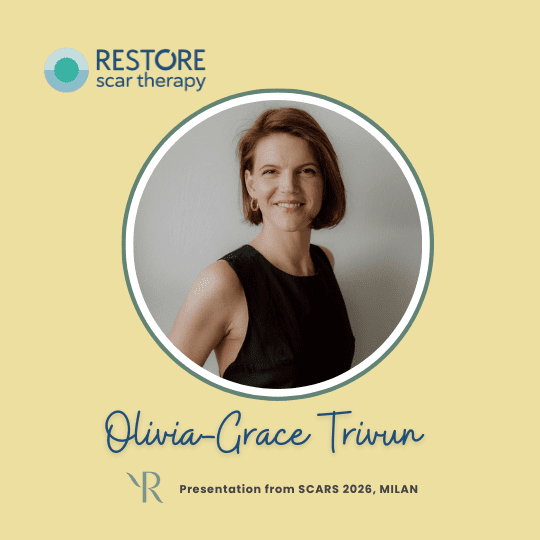
At the global conference, SCARS 2026 Milan, Restore Therapy trained clinician and manual therapist, Olivia-Grace Trivun, founder of Recovery Space (Switzerland), presented an innovative and deeply integrative model for post-surgical scar rehabilitation. One that addresses not only tissue healing, but also function, sensation, and the psychological experience of recovery.
“With more than 22 years of clinical experience as a manual therapist, I have created an integrative post-surgical aftercare model designed to enhance physiological, functional, and psychological recovery, ultimately optimizing patient outcomes.”
— Olivia-Grace Trivun
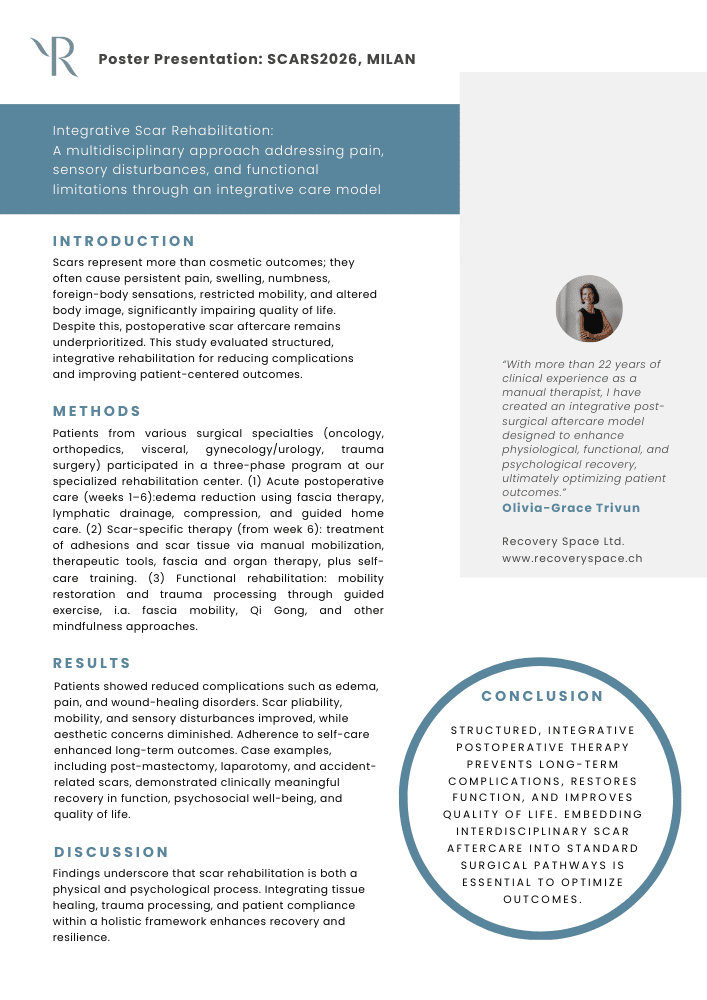
We share her poster presentation on ‘Why Scar Rehabilitation Matters’
Scars are often treated as cosmetic outcomes, yet for many patients they are the source of persistent pain, swelling, numbness, foreign-body sensations, restricted mobility, and changes in body image. These issues can significantly impact daily function and quality of life.
Despite this, structured postoperative scar after-care remains under-prioritised within many surgical pathways. Olivia’s work highlights the urgent need to rethink scar management as a core component of recovery, rather than an optional add-on.
The Integrative Scar Rehabilitation Model
Patients from a wide range of surgical specialties—including oncology, orthopaedics, visceral surgery, gynaecology, urology, and trauma surgery—participated in a three-phase rehabilitation programme delivered at Recovery Space, a specialised rehabilitation centre in Switzerland.
Phase 1: Acute Post-operative Care (Weeks 1–6)
The initial phase focuses on supporting early healing and preventing complications through:
Phase 2: Scar-Specific Therapy (From Week 6)
Once tissue healing is established, treatment progresses to targeted scar intervention, including:
Phase 3: Functional Rehabilitation & Trauma Processing
The final phase integrates movement, nervous system regulation, and body awareness:
Clinical Outcomes
Across patient cases, outcomes demonstrated meaningful improvements:
Strong patient adherence to self-care protocols was a key factor in achieving sustained, long-term results. Case examples including post-mastectomy scars, laparotomy scars, and accident-related injuries, illustrated significant functional and emotional recovery.
A Holistic Perspective on Healing
A central insight from this work is that scar rehabilitation is both a physical and psychological process. Integrating tissue healing with trauma-informed care and patient education creates a more resilient recovery pathway.
By addressing the body as an interconnected system, rather than isolated tissues, this approach supports not just healing, but long-term function, confidence, and autonomy.
Key Takeaway
Structured, integrative postoperative therapy prevents long-term complications, restores function, and improves quality of life.
Embedding interdisciplinary scar aftercare into standard surgical pathways is essential to optimise patient outcomes.
About the Presenter
Olivia-Grace Trivun
Manual Therapist & Founder, Recovery Space Ltd.
Trained in Restore Therapy techniques and offering therapy from her clinic in Switzerland
Website: https://recoveryspace.ch/en/
Instagram: @recoveryspace.ch